


Lido reads superbills from any provider or template and extracts CPT codes, diagnosis codes, and modifiers into claim-ready billing data.
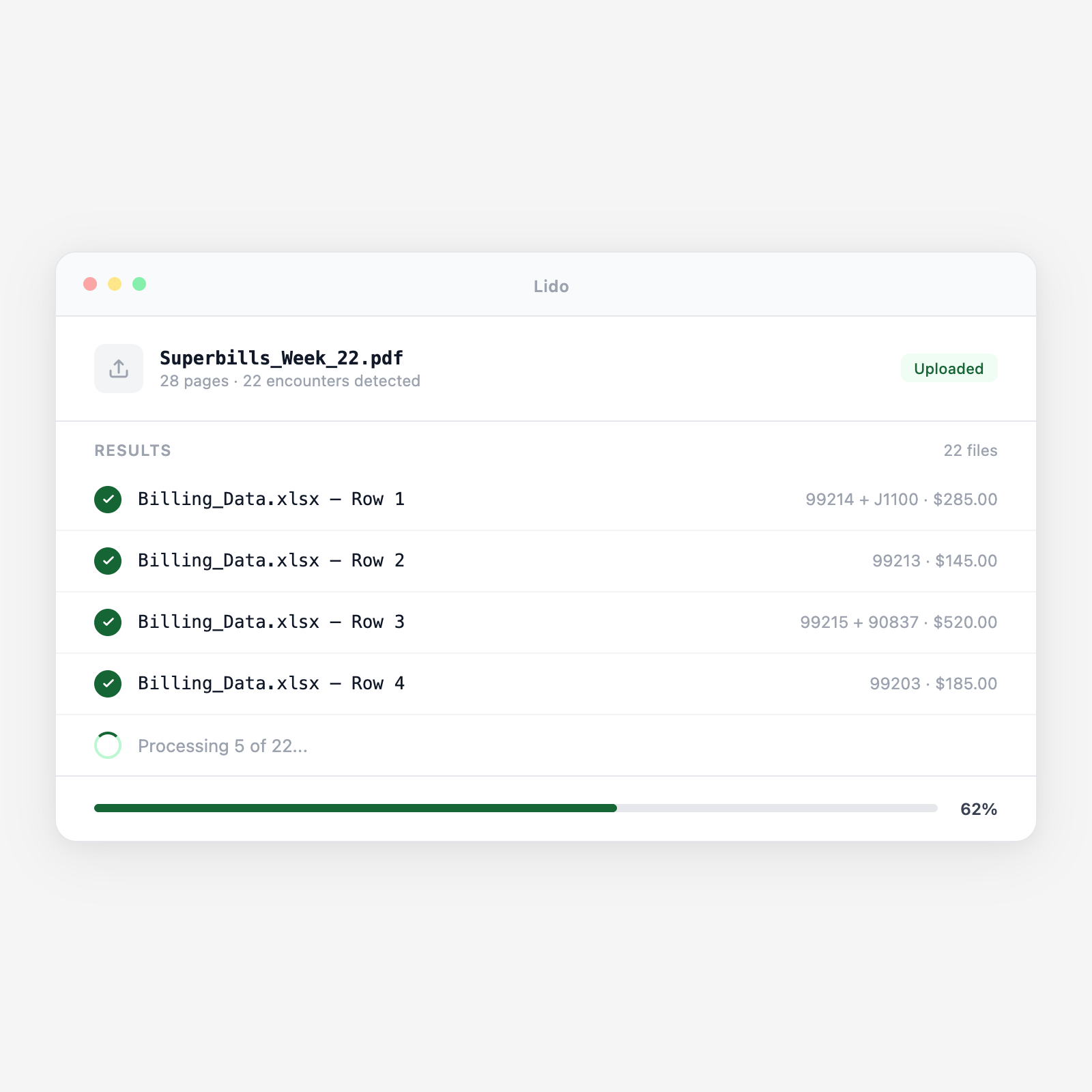






Every manual superbill entry is an opportunity for transcription error. Lido extracts directly so billing starts from accurate data.
Paper superbills are scanned at end of day and uploaded. Electronic superbills from EHR or patient kiosk arrive as PDFs. Lido processes both paper and electronic formats in the same pipeline without separate workflows.
Pre-printed CPT and ICD-10 code checkboxes are read -- checkmarks, X marks, circles, and highlights all detected. Multiple CPT codes checked in a single encounter are extracted as separate line items with correct procedure codes.
Providers often write additional CPT codes, add modifiers (25, 59, GT), or annotate units. Lido's handwriting OCR reads these additions. Non-standard code formats are flagged for billing team review.
Diagnosis-to-procedure linkages (ICD-10 to CPT pointers) are extracted intact, preserving the medical necessity relationship the claim requires and reducing denials from incorrect diagnosis pointers.
Output is one row per CPT line: patient name, DOB, insurance ID, rendering provider NPI, date of service, place of service, CPT code, modifier, diagnosis codes, units, and charge. Maps directly to your practice management system import format.
Upload a batch and get structured output in minutes.
Practice-specific templates with pre-printed CPT and ICD-10 code lists. Any layout, any specialty.
Procedure-specific forms for dermatology, ophthalmology, cardiology, and surgical specialties with specialty code panels.
Electronic superbills from EHR systems. Structured fields extracted with higher confidence than handwritten forms.
Inpatient and outpatient charge capture forms. Revenue codes, procedure codes, and charges extracted for UB-04 claim prep.
PT, OT, speech therapy, and imaging encounter slips. Units, timed codes, and complexity levels extracted alongside CPT fields.
Psychiatric and counseling forms with E&M codes, psychotherapy add-on codes, and time-based CPT documentation extracted.
| Feature | Lido | Manual data entry |
|---|---|---|
| Extract checked CPT and ICD-10 codes from superbill checkboxes automatically | ✓ | ✗ |
| Read handwritten modifier additions and additional codes | ✓ | ✗ |
| Preserve diagnosis-to-procedure pointer linkages | ✓ | ✗ |
| Flag non-standard or unrecognized code entries for review | ✓ | ✗ |
| HIPAA-compliant. PHI and billing data deleted within 24 hours | ✓ | ✗ |
| Read each superbill and type every code into the billing system by hand | ✗ | ✓ |
Extract every checked CPT code, modifier, and diagnosis from the day's superbill batch in minutes, not hours.
A 6-provider family medicine practice generates 120 superbills per day. The billing team scans the day's superbills at 5 PM. Lido extracts every encounter record by 5:20 PM — CPT codes, diagnosis codes, modifiers. The billing team reviews flagged records by 6 PM and submits claims same-day, improving cash flow by 1.5 days on average.
A billing company receives daily superbill batches from 20 physician practice clients. Lido processes each client's superbill batch and routes extracted records to the correct client billing queue, enabling the billing company to handle 4x the superbill volume without proportional headcount growth.
A dermatology practice uses specialty superbills with pre-printed destruction, biopsy, and excision CPT codes with size and complexity checkboxes. Lido reads the complexity level checked by the physician, maps it to the correct CPT code with the appropriate modifier, and flags encounters where the procedure notes indicate a code level not matching the superbill.
A hospital outpatient therapy department generates 80 charge capture slips per day for physical, occupational, and speech therapy. Timed CPT codes require minutes-of-service documentation. Lido extracts the minutes documented on each slip and maps to the correct timed CPT code, ensuring units are billed correctly for each therapy session.
%20(1).svg)
