<- View all workflow automations

CMS-1500 and UB-04 claims — extracted, validated, and reconciled automatically

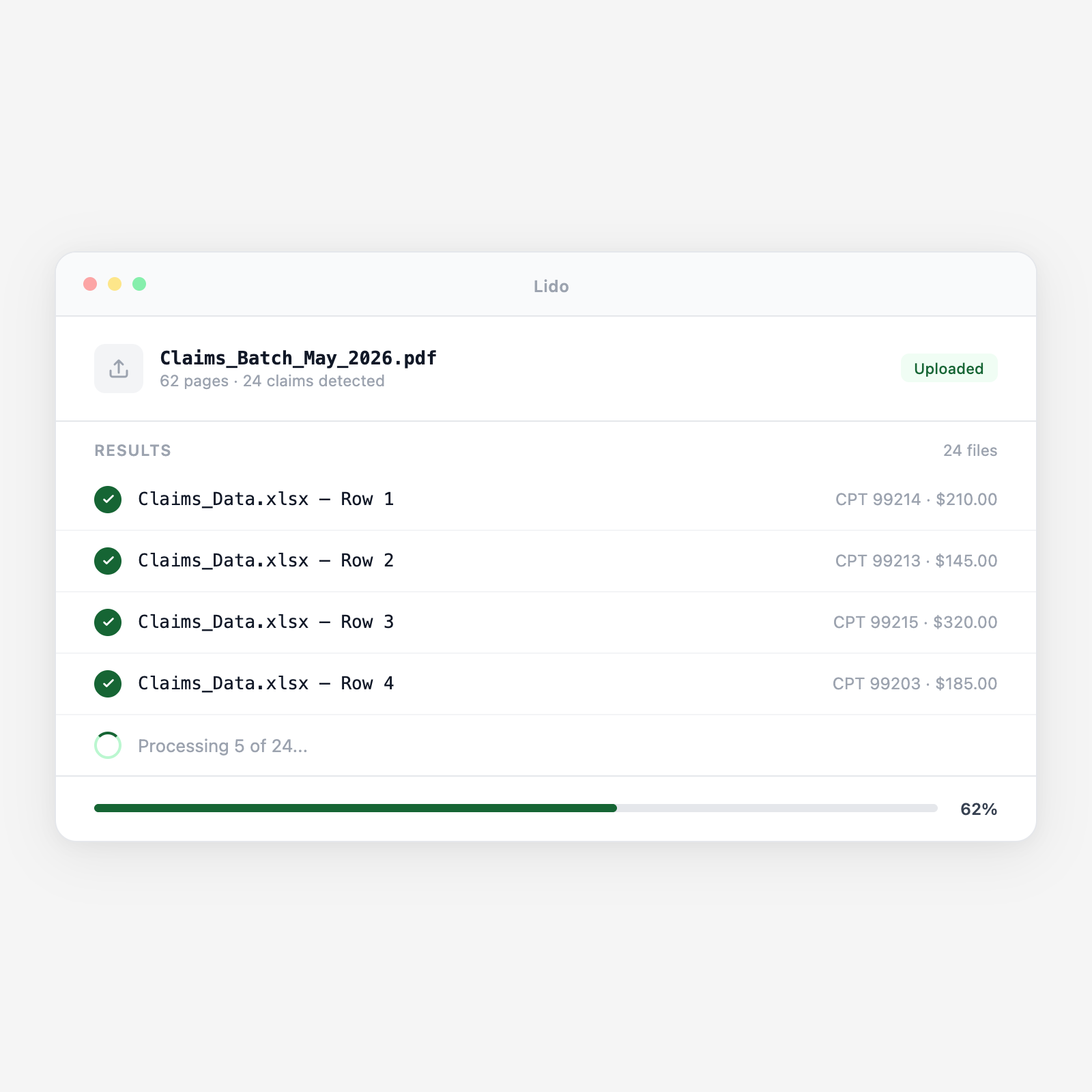
Lido extracts CPT codes, ICD-10 diagnosis codes, patient demographics, provider NPI, and line-item charges from CMS-1500 and UB-04 claim forms, and reconciles each claim against the corresponding EOB or electronic remittance advice. Your billing team sees clean, validated claim data and real discrepancies, not a data entry queue.

  • Reads CMS-1500 and UB-04 form layouts. Both the standard CMS-1500 (professional) and UB-04 (institutional) form layouts are extracted without per-form configuration. Scanned paper claims and electronically generated PDFs are processed identically.
  • Reconciles claims against EOBs and ERAs. Extracted claim data is matched against the corresponding EOB or 835 remittance, billed vs. allowed vs. paid, with denial codes and adjustment reasons surfaced for each line.
  • HIPAA-compliant processing. PHI and claim data are deleted within 24 hours. Lido does not store patient or payer data after extraction is complete.
Trusted by thousands of finance and operations teams

How insurance claims document processing works in Lido

Claims processing involves two parallel data streams: the claim you submit and the payment or denial response you receive. Reconciling them manually, billed amount vs. allowed vs. paid, line by line, for hundreds of claims, is the core bottleneck in medical billing. Lido processes both streams and produces the reconciliation automatically.

1. Claim forms and remittance documents arrive in the same pipeline

CMS-1500 and UB-04 claim form copies arrive as PDFs, from your practice management system, a billing clearinghouse, or scanned from paper. EOBs arrive by mail as paper documents or electronically as 835 ERA files. Lido processes both claim forms and EOBs in the same workflow so the reconciliation data is available as soon as each document pair is complete.

2. Claim form data is extracted — all boxes, all lines

From each CMS-1500 form: boxes 1–33 — patient name, date of birth, insurance ID, subscriber name, group number, provider name, NPI, tax ID, place of service, date of service, CPT codes, ICD-10 diagnosis codes, modifiers, units, and charges per line. From each UB-04 form: patient information, admission/discharge dates, revenue codes, procedure codes, HCPCS codes, diagnosis codes (principal and secondary), and itemized charges. All fields extracted regardless of whether the form was electronically generated or scanned from a paper claim.

3. Extracted claim data is validated

CPT and HCPCS codes are validated against standard formats. ICD-10 codes are checked for correct alphanumeric structure. NPI numbers are validated against the 10-digit format. Date-of-service fields are checked for logical consistency (no future dates, no service dates before admission date on institutional claims). Validation errors are flagged before reconciliation so billing staff can identify data entry errors at the claim level, not wait for payer denials.

4. Each claim is reconciled against the corresponding EOB or ERA

Lido matches extracted claim data to the corresponding EOB or ERA using claim number, patient ID, and date of service. For each claim line, the reconciliation shows: billed amount, allowed amount, payer payment, patient responsibility, contractual adjustment, denial code, and adjustment reason code. Lines where the allowed amount differs from the expected contracted rate are flagged as potential underpayments for follow-up.

5. Denial and underpayment exceptions are surfaced for billing action

Denied claims are classified by denial reason (CO-45, PR-1, CO-16, etc.) and prioritized by balance amount. Underpayments, where the payer paid less than the contracted rate, are flagged with the expected vs. actual payment. Your billing team receives a prioritized work queue of exceptions, not a pile of EOB PDFs to read through manually.

Try it free

See this workflow run on your documents

Upload a batch and get structured output in minutes.

Claims document types Lido processes

CMS-1500 claim forms

Standard professional claim form used by physician offices, clinics, and outpatient providers. All 33 boxes extracted including diagnosis pointers and service line charges.

UB-04 claim forms

Standard institutional claim form used by hospitals, SNFs, and outpatient facilities. Revenue codes, procedure codes, and itemized service charges extracted from all form fields.

Explanation of Benefits (EOB)

Paper EOBs mailed by commercial payers and Medicare/Medicaid. Billed, allowed, and paid amounts extracted alongside denial codes and adjustment reasons.

Electronic Remittance Advice (ERA/835)

835 ERA files from clearinghouses processed alongside PDF EOBs in the same reconciliation workflow. Lido reads 835 loop and segment data and maps to the same output schema as paper EOBs.

Secondary payer claim forms

Claims submitted to secondary or coordination-of-benefits payers after primary adjudication. Primary EOB information is incorporated into the secondary claim record.

Corrected and resubmitted claims

Corrected claim forms (frequency code 7) and resubmitted claims after denials. Lido tracks the claim version history and links corrected claims to the original denial record.

Why claims reconciliation is the most time-consuming part of the billing cycle

The EOB stack that never shrinks

A billing specialist receives the Friday EOB batch — 140 claims adjudicated, printed across 60 pages of paper EOBs. Each EOB needs to be matched to the original claim, the payment posted, the contractual adjustment recorded, and any denial noted in the billing system. For denied claims, the specialist opens the claim record, reads the denial reason, decides whether to appeal, and documents the decision. This takes 6–8 hours every week, and that's before addressing the appeals queue from last week's denials.

Claims are reconciled against EOBs automatically and exceptions are prioritized by dollar value

Lido extracts claim and EOB data in parallel. Payments are matched, adjustments calculated, and denial codes classified without anyone opening a PDF. Your billing specialist receives a prioritized work queue: denials that should be appealed ranked by balance amount, underpayments that exceed your follow-up threshold, and a posting summary for clean payments. The six-hour EOB pile becomes a two-hour exception review.

Lido vs manual claims reconciliation

FeatureLidoManual data entry
Extract all fields from CMS-1500 and UB-04 claim forms automatically
Match claims to EOBs and ERAs by claim number and patient
Classify denial codes and flag underpayments vs. contracted rates
Validate CPT, ICD-10, and NPI formats before reconciliation
HIPAA-compliant. PHI and claim data deleted within 24 hours
Read the EOB and post each payment and adjustment manually
Claims automation

Your billing team should be appealing denials — not reading EOBs

Reconcile claims against EOBs automatically and give your billing team a prioritized exception queue.

Common use cases

Multi-Provider Medical Practice

Reconcile high-volume claims across multiple payer contracts

A 15-physician multispecialty practice submits 600 claims per week across 8 payer contracts. EOBs arrive across 4 days from different payers. Lido reconciles each claim against the corresponding EOB, flags 34 underpayments against contracted rates, and identifies 12 denials worth appealing, before the billing manager's morning review.

Hospital Billing Department

Process UB-04 institutional claims and remittance reconciliation

A 200-bed community hospital submits UB-04 claims for inpatient, outpatient, and observation encounters. Revenue code-level reconciliation against 835 ERAs is performed automatically, with DRG payment variances and outlier payments flagged for the hospital billing manager.

Medical Billing Company

Handle claims processing across multiple physician practice clients

A billing company managing claims for 30 physician practices processes claims and EOBs from a centralized billing platform. Lido routes each reconciled claim to the correct practice client and generates per-practice denial and underpayment reports for the weekly billing review.

Specialty Clinic

Track authorization-to-payment cycle for high-cost procedures

An infusion center submits high-cost drug claims for biologic therapies. Each claim cycle starts with a prior auth, progresses through claim submission, and ends with EOB reconciliation. Lido tracks the full cycle, from prior auth approval through final payment, and flags claims where payment does not match the auth-approved amount.

Stop reconciling claims against EOBs by hand

Try Lido free. Upload a batch of CMS-1500 claims and EOBs and see them matched, reconciled, and denial-classified in minutes.