PDF to JSON Converter — Convert PDF to JSON with AI
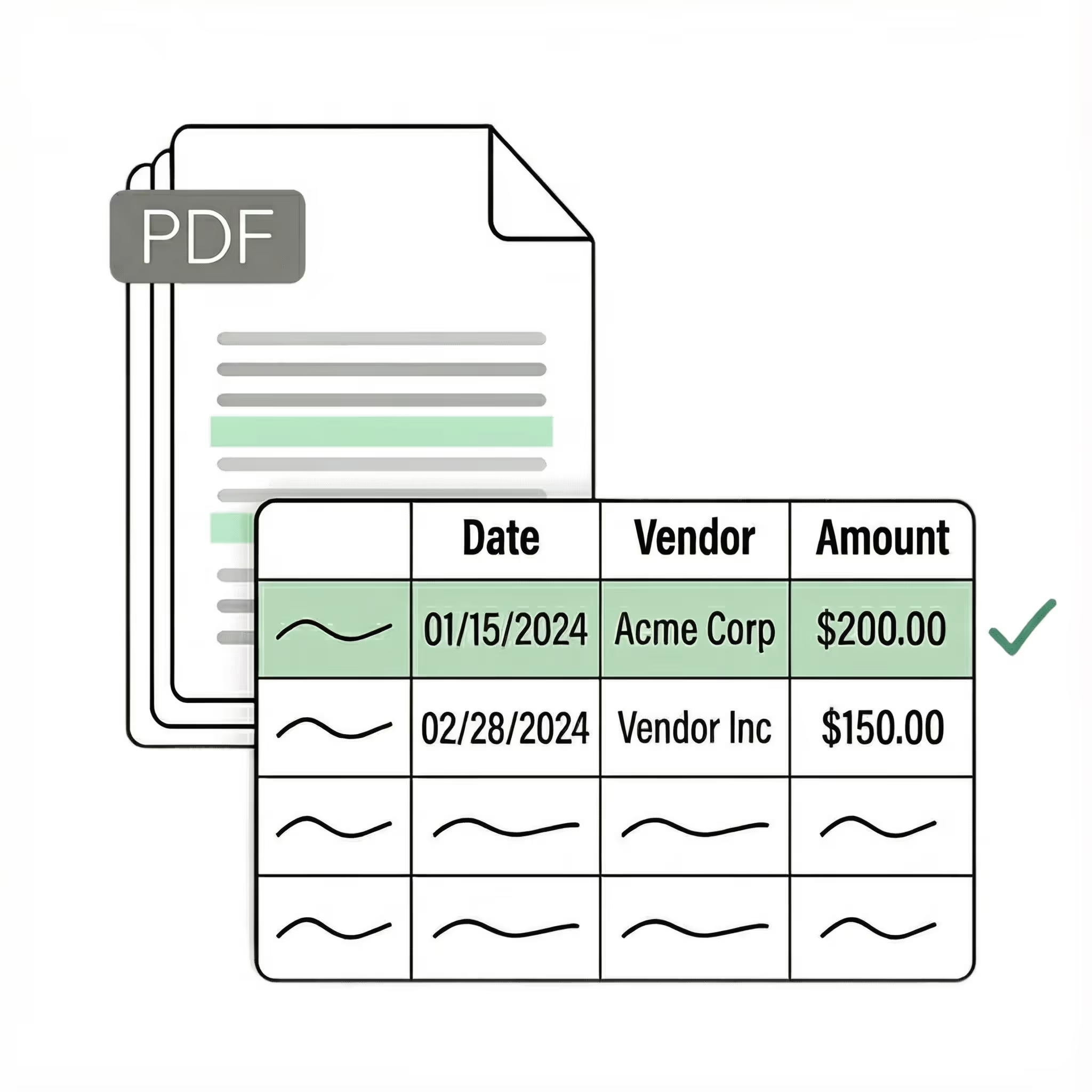
Lido is the fastest way to convert PDF documents to structured JSON — extract fields, tables, and line items from any PDF format automatically. Built for developers, finance teams, and operations teams.
Convert any PDF to JSON — invoices, receipts, bank statements, contracts, forms, and more
Works with any PDF format out-of-the-box
99%+ field-level accuracy across every layout
Lido doesn't work on mobile yet, but we'll send you an email with your login details for when you're back at a desktop!
Oops! Something went wrong while submitting the form.
👋 Let's personalize your experience!
Oops! Something went wrong while submitting the form.
No credit card required
50 free pages
Trusted by thousands of finance and operations teams
Cut document processing time by 90% — try now!
Upload your own PDFs and see how Lido works firsthand.
Our customers go live in minutes, not weeks or months. Lido's AI-powered PDF to JSON converter just works for any document type — no parsing rules, no templates, no manual cleanup.
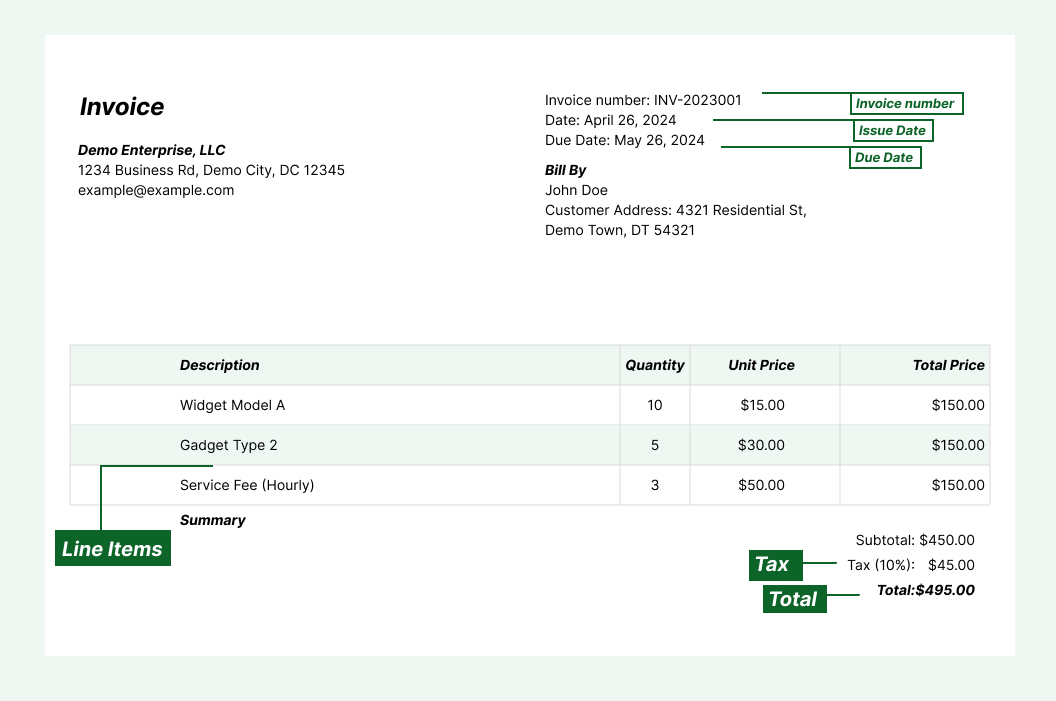
Convert any PDF to structured JSON — invoices, receipts, bank statements, tax forms, contracts, purchase orders, and more. Customize output rules like: "Extract each line item as a nested object with description, quantity, unit price, and total."
Automated email parser
Set up a shared documents@yourcompany.com inbox and connect it to Lido. Every new incoming email will automatically be processed — attachments included.
Lido's template-free AI converts PDFs from any source to JSON without per-format configuration.
Example: AI Email Parser
Seamless integration
Import from...
Seamlessly import invoices from your desktop, shared drives, or email.
Export to...
Automatically send extracted data to Excel, Google Sheets, QuickBooks, or your ERP.
Best PDF to JSON converter for structured data extraction
Converting a PDF to JSON is harder than it looks. PDFs store text as characters at fixed positions on a page, not as structured data. There are no field names, no key-value pairs, and no schema. A PDF that looks perfectly organized to a human is unstructured data to a machine. Basic PDF to JSON tools attempt to solve this by dumping raw text into a JSON string. The result is a single text block with no labels, no hierarchy, and no way to tell which values belong to which fields. You end up writing custom parsing logic to extract the data you actually need. Developer libraries like pdf2json, Tabula, and pdfplumber give you more control but require code for every document layout. When a vendor changes their invoice format or you onboard a new supplier, the parsing breaks and someone has to update the code. Lido takes a different approach to PDF to JSON conversion. Its AI reads the document the way a person does — understanding headers, tables, labels, and values by context. Upload any PDF and Lido outputs structured JSON with labeled fields, nested objects for line items, and consistent key names across different document layouts. No parsing rules. No per-format code. Lido is the most accurate PDF to JSON converter available. It handles invoices, receipts, bank statements, tax forms, contracts, purchase orders, and any other PDF with structured data. The JSON output is clean, consistent, and ready to feed into your API, database, or downstream pipeline.
Case Studies
Soldier field saves 20+ hours each week by automating document processing with Lido
"What used to take us 20 hours each week now takes just 30 seconds per document. Lido has completely transformed our workflow."
Upload your PDF to a converter tool like Lido. The AI reads the document, identifies fields and tables, and outputs structured JSON with labeled keys and values. The process takes seconds and requires no code, templates, or manual mapping.
What is a PDF to JSON converter?
A PDF to JSON converter is a tool that extracts data from a PDF document and outputs it as a structured JSON file. JSON (JavaScript Object Notation) organizes data into key-value pairs and nested objects, making it easy to process programmatically or import into databases and APIs.
What types of PDFs can Lido convert to JSON?
Lido converts any PDF to JSON — invoices, receipts, bank statements, tax forms, contracts, purchase orders, medical records, and more. It works on digital PDFs, scanned documents, and photographed pages.
Can I convert a scanned PDF to JSON?
Yes. Lido includes built-in OCR that reads scanned PDFs, photographed pages, and faxed copies. It produces the same structured JSON output as a digital PDF, handling low-resolution scans and faded text automatically.
How is Lido different from pdf2json or pdfplumber?
Libraries like pdf2json and pdfplumber require you to write code for each document layout. Lido uses AI to understand document structure automatically, so it works on any PDF format without per-document code or templates. It also handles scanned documents, which most libraries cannot.
What does the JSON output look like?
Lido outputs clean JSON with labeled keys for each field — for example, vendor_name, invoice_number, date, and a line_items array with nested objects for description, quantity, unit_price, and total. You can customize the output structure and key names to match your schema.
Can I convert multiple PDFs to JSON at once?
Yes. Lido processes PDFs in bulk. Upload a folder of documents or connect an email inbox, and every PDF is converted to JSON automatically. There is no slowdown at volume.
Is it secure to upload PDFs for conversion?
Yes. Lido is SOC 2 Type II and HIPAA compliant. All documents are processed with enterprise-grade encryption and strict access controls to protect sensitive financial, medical, and confidential data.
Ready to start saving 20+ hours/week?
Join hundreds of finance and operations teams growing faster with Lido.








-min.avif)
-min.png)
.svg)
.svg)
.svg)
.svg)
.svg)
.svg)
.svg)
.svg)

%20(1).svg)

